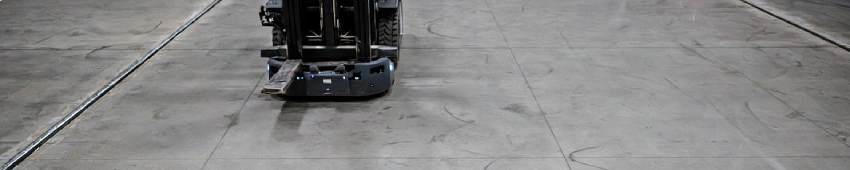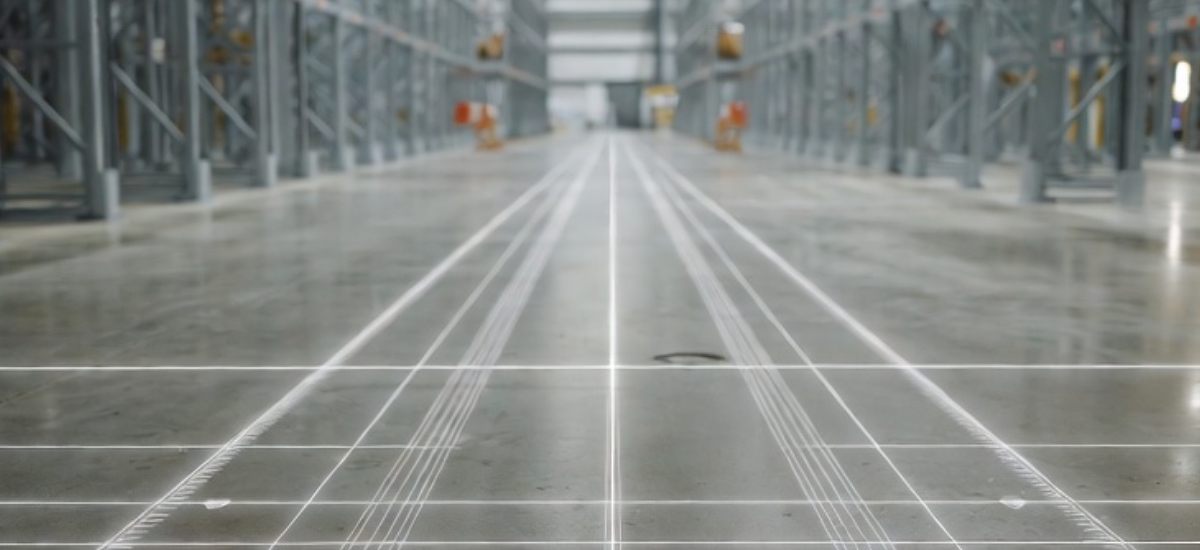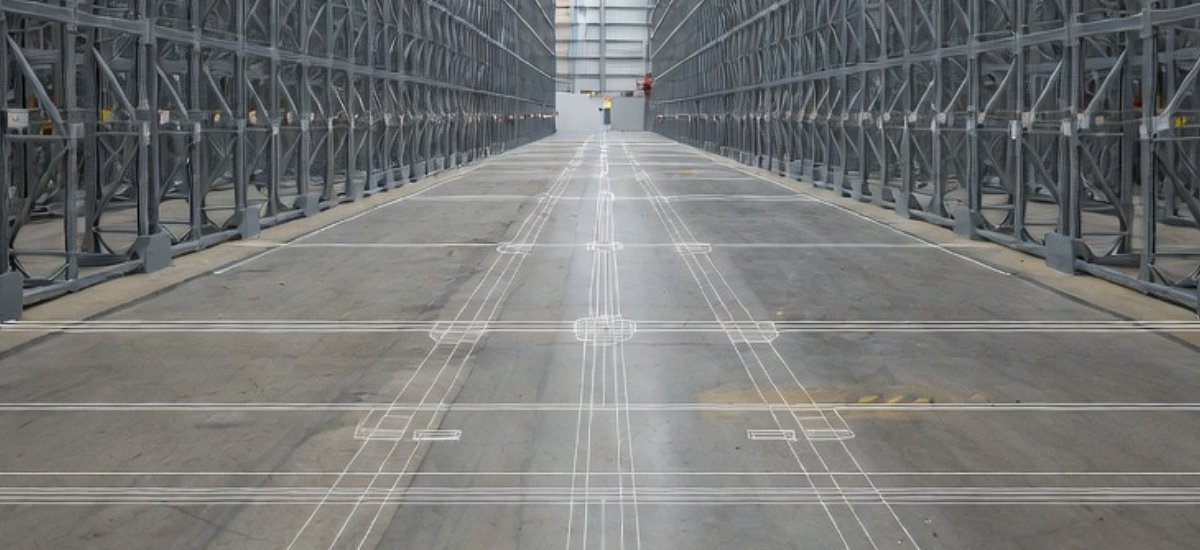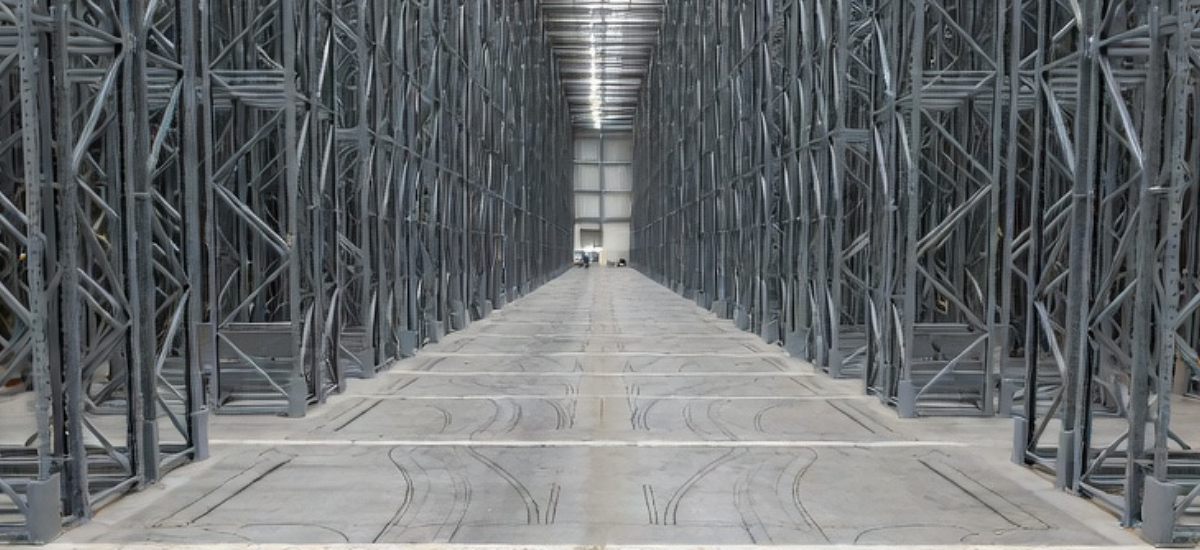


In automated facilities, floor performance is defined by predictability over time—not appearance at turnover.
In automated warehouses, the concrete floor is not a passive surface. It is a load-bearing, navigation critical, tolerance driven system input that directly influences robot behavior, system uptime, and lifecycle operating cost. When floor performance is misunderstood or treated as a finish trade, automation systems inherit uncontrolled risk.
Autonomous Mobile Robots (AMRs), AS/RS cranes, and Very Narrow Aisle (VNA) vehicles operate within tight mechanical and algorithmic tolerances. Their guidance systems assume predictable wheel contact, repeatable elevation profiles, and consistent friction across thousands of cycles per day. Any deviation curling, moisture-induced movement, surface waviness, or joint instability introduces error that software cannot fully compensate for.
Unlike manual operations, automation systems do not adapt intuitively. Robots respond deterministically. A localized slab anomaly may trigger speed reductions, path recalculations, false obstacle detection, or cumulative navigation drift. Over time, these responses compound into throughput loss, premature component wear, and increased maintenance intervention. The result is not a visible floor failure, but a performance failure upstream in the automation stack.
Warehouse flooring engineering, therefore, must be approached as part of the automation design process not as a downstream construction detail. Decisions around slab thickness, reinforcement strategy, moisture control, flatness tolerances, joint layout, and surface treatment all influence how machines perceive and interact with the environment.
Critically, many automation issues attributed to software tuning or robot hardware originate from the floor. Physics precedes algorithms. A slab that moves, deforms, or behaves inconsistently over time erodes the assumptions embedded in navigation and control systems. Once automated operations are live, correcting these conditions becomes disruptive and expensive.
Engineering an automation-ready warehouse floor means designing for repeatability, stability, and verification. It requires measurable standards, disciplined execution, and validation aligned with how robots actually operate not how floors traditionally look.
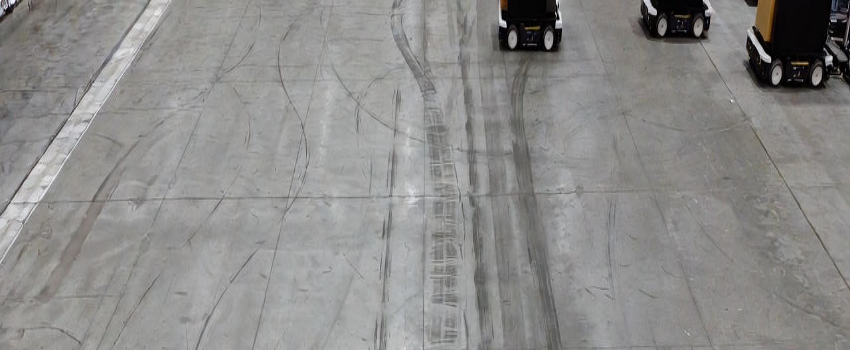
Structural Slab Design and Load Path Control
The structural slab establishes the mechanical baseline for automation performance. Load paths must remain stable under static racking, dynamic robot traffic, and long-term environmental exposure. Unlike conventional warehouses, automated facilities impose highly repetitive, localized wheel loads that magnify the impact of minor deflections.
Slab thickness, subgrade preparation, and reinforcement strategy directly affect vertical movement and differential settlement. Even small deflections can alter wheel contact geometry, increasing vibration and degrading sensor accuracy. For AMRs with rigid wheels, these effects are immediate and measurable.
Engineering decisions must prioritize stiffness and uniform support not just ultimate strength. The objective is to minimize micro-movement that accumulates into navigation inconsistency.
Flatness, Levelness, and Elevation Predictability
Flatness and levelness are not abstract quality metrics in automation environments; they are navigation constraints. AMRs rely on consistent elevation profiles to maintain odometry accuracy and path repeatability. Deviations outside tolerance introduce cumulative positional error.
Traditional FF/FL targets may be insufficient if not aligned with robot travel paths and operating zones. Automated aisles, charging areas, and high-traffic loops demand tighter control than peripheral storage zones.
More importantly, flatness must be maintained over time. Curling, shrinkage, or moisture-related movement erodes initial compliance, shifting the floor outside the operating envelope assumed during system commissioning.
Moisture Control and Dimensional Stability
Moisture is one of the most underestimated variables in warehouse flooring engineering. Elevated moisture levels drive slab movement, joint activation, surface softening, and coating incompatibility all of which affect robot behavior.
As slabs gain or lose moisture, dimensional changes alter elevation continuity and joint performance. Robots respond by adjusting speed, increasing correction cycles, or flagging faults. These responses are often misdiagnosed as software sensitivity rather than environmental instability.
Engineering for automation readiness requires moisture management strategies that prioritize dimensional stability, not just floor covering compatibility.
Joint Engineering and Wheel Interaction
Joints are unavoidable but their behavior is controllable. In automated facilities, joints represent repeated mechanical events occurring thousands of times per shift. Poorly designed or executed joints introduce impact, vibration, and sensor noise.
Joint width, filler selection, edge support, and alignment relative to robot travel paths all influence performance. For solid-wheel robots, even minor joint degradation becomes a persistent disturbance.
Effective joint engineering reduces dynamic load transfer, protects wheel assemblies, and preserves navigation consistency across the floor’s lifecycle.
Surface Characteristics and Sensor Reliability
Surface texture affects traction, braking consistency, and optical sensor performance. Overly aggressive profiles increase wear; overly smooth surfaces reduce control. Inconsistent finishes create variable friction zones that disrupt motion planning.
For vision-based navigation systems, reflectivity and surface uniformity influence sensor confidence. Flooring engineering must consider how surfaces interact with both mechanical wheels and digital perception systems.
The goal is not aesthetics, but controlled interaction between robot and floor.
Testing, Validation, and Lifecycle Verification
Automation-ready floors are not assumed they are verified. FF/FL testing, elevation mapping, and post-installation validation provide measurable assurance that the slab meets operational requirements.
Equally important is documenting baseline conditions. As automated systems operate over years, having reference data allows teams to distinguish between normal wear and performance-critical deviation.
Floor performance is not static. Engineering processes must account for monitoring, maintenance, and re-validation as part of the automation lifecycle.