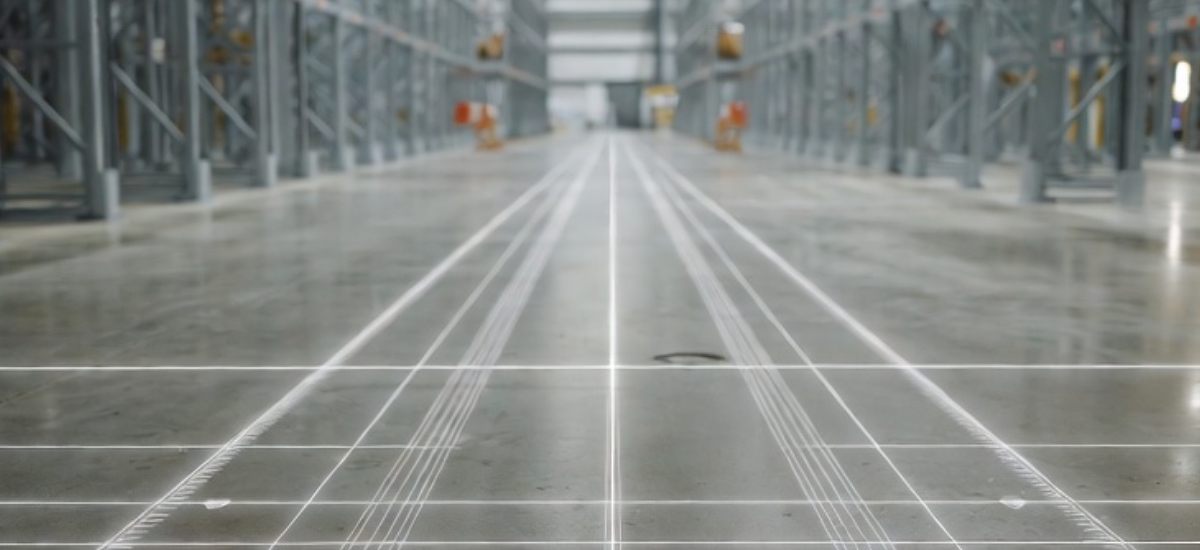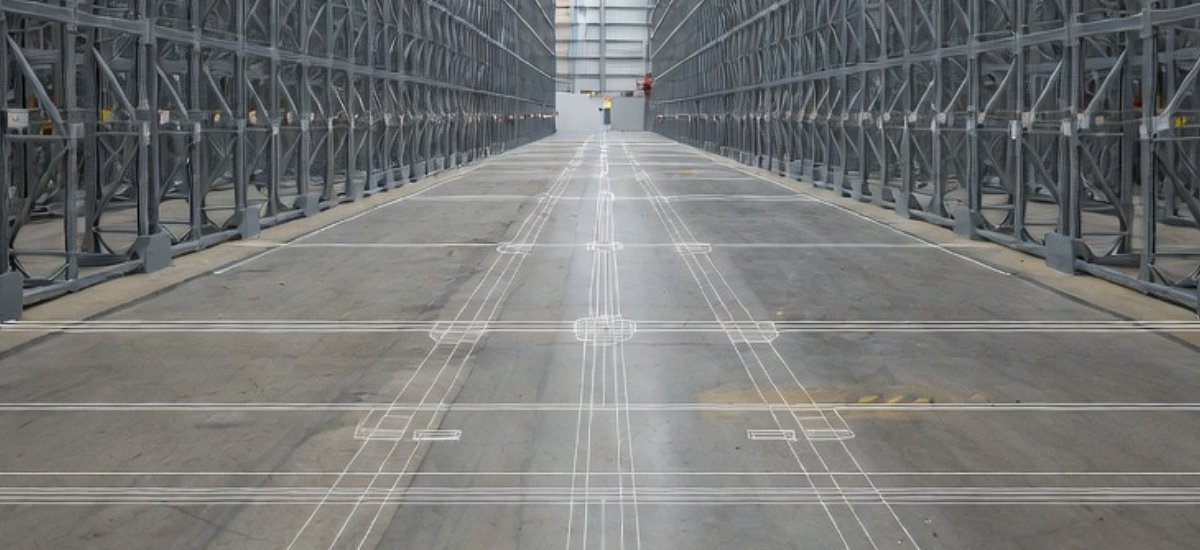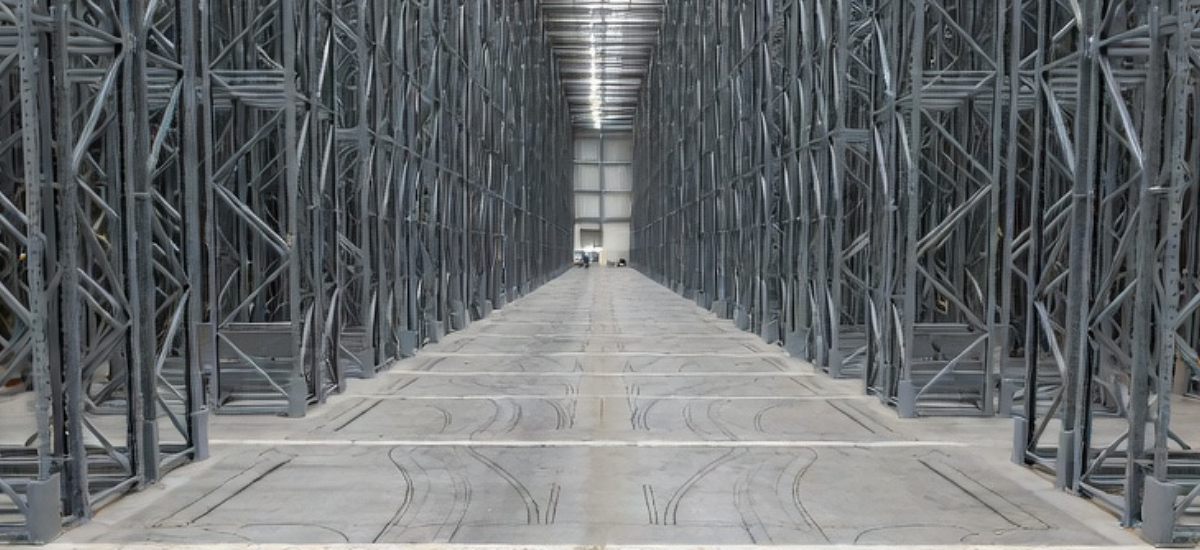


In automated facilities, slab preparation defines the upper limit of navigation stability; no control system can outperform the physical plane it references.
In high traffic automated distribution centers, slab preparation is not a construction step it is a system calibration phase. Once autonomous mobile robots (AMRs), shuttle systems, and automated storage and retrieval systems (AS/RS) are deployed, the concrete slab becomes a fixed input. Errors introduced during preparation propagate directly into navigation instability, mechanical wear, and throughput loss.
Automation depends on repeatability. That repeatability is constrained by slab geometry, surface uniformity, load response, and long term dimensional stability. While design documents may specify FF/FL values, joint layouts, or flatness tolerances, those requirements only become operationally meaningful through execution. A slab that meets paper specifications but is poorly prepared will not behave predictably under continuous robotic traffic.
High traffic automation environments amplify small defects. Minor surface deviations alter wheel-floor contact patterns, increasing vibration and sensor noise. Inconsistent densification or curing introduces differential hardness, accelerating wear in robot travel paths. Improper joint preparation creates localized compliance zones that force repeated micro-corrections by navigation systems. None of these failures present as immediate breakdowns; instead, they degrade performance incrementally, making root cause analysis difficult once operations are live.
Unlike manual forklift environments, automated facilities do not adapt to the floor. Robots assume the floor is stable, planar, and consistent across thousands of cycles per day. When that assumption is violated, software compensates until mechanical limits are reached resulting in reduced speed, increased maintenance, or system pauses.
Slab preparation is therefore a risk management exercise. It links design intent to operational reality by controlling variables that software cannot correct: surface geometry, hardness uniformity, joint behavior, and early life wear characteristics. Decisions made during preparation determine whether the floor behaves as a stable reference plane or as a source of continuous disturbance.
This stage closes the loop between engineering and execution. The slab is no longer abstract tolerance data; it becomes a physical control surface governing how automation moves, senses, and repeats.
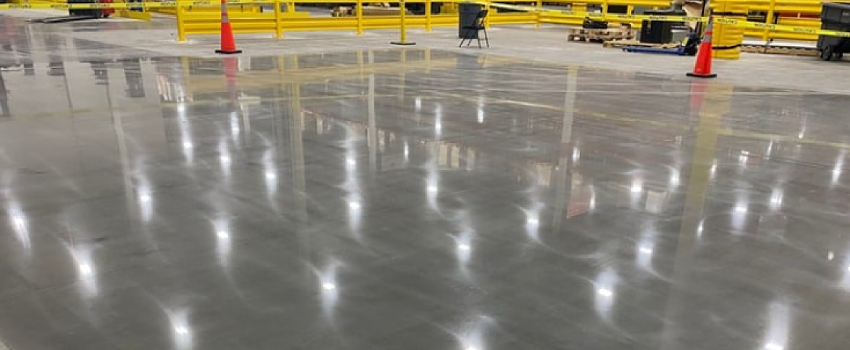
Slab Surface Conditioning for Robotic Traffic Consistency
Surface conditioning establishes the mechanical interface between robotic wheels and the slab. In automated distribution centers, this interface must remain consistent across thousands of repetitive passes, not just meet visual or short-term durability criteria.
Grinding sequences must prioritize planar continuity over cosmetic finish. Inconsistent removal rates create subtle undulations that are imperceptible to the eye but detectable by robot sensors. These micro-variations alter wheel loading and traction, introducing cumulative navigation drift along repeat paths.
Equally critical is uniform surface hardness. Variations caused by uneven curing, patching, or inconsistent densifier penetration result in differential wear. Over time, robot lanes polish unevenly, creating embedded guidance errors that did not exist at commissioning.
Surface conditioning should therefore be validated against expected traffic patterns, ensuring that the slab responds uniformly under continuous robotic load rather than isolated test passes.
Joint Preparation as a Navigation Stability Factor
Joints are structural necessities, but in automated environments they are also navigation events. Every joint crossing introduces a mechanical discontinuity that robots must absorb without deviation.
Poorly prepared joints whether due to improper saw timing, inadequate edge support, or incorrect filler selection create localized compliance. Under high frequency robotic traffic, these zones deform differently than adjacent slab panels, producing repeatable disturbances in robot motion.
Joint fillers must be selected and installed based on load cycling, not just static load ratings. Fillers that perform acceptably under forklifts may shear, pump, or recess under constant robotic passes, creating shallow depressions that grow over time.
Proper joint preparation ensures that joints behave as controlled transitions rather than variable inputs into the navigation system. The goal is not eliminating joints, but stabilizing their long-term mechanical response.
Slab Flatness Preservation During Execution
Achieving specified FF/FL values is only part of the execution challenge. Preserving those values through curing, finishing, and early traffic is what determines operational success.
Premature access, uneven curing conditions, or localized load introduction during early slab life can permanently alter flatness. These distortions often fall within tolerance bands when measured globally, yet create localized zones that disrupt robot behavior.
Execution sequencing must therefore account for when and how the slab begins interacting with construction traffic, equipment staging, and environmental exposure. Flatness is not lost in a single event; it degrades through unmanaged interactions during the slab’s most vulnerable phase.
Preservation strategies such as controlled access, curing uniformity, and targeted protection of high-precision zones are essential to maintaining the geometric assumptions embedded in automation layouts.
Validation and Handoff to Automation Systems
Execution credibility is finalized at validation. Before automation systems are commissioned, the slab must be treated as a tested subsystem, not a background condition.
Validation includes confirming flatness retention, joint integrity, surface hardness consistency, and absence of localized anomalies in high traffic zones. These checks establish a performance baseline against which future wear and deviations can be measured.
A documented slab condition at handoff allows engineers and facility operators to distinguish between floor driven issues and system-driven issues during operations. Without this baseline, responsibility becomes diffuse and corrective actions reactive.
In automated distribution centers, successful execution is not defined by project closeout it is defined by whether the slab continues to behave as a stable reference plane long after robots begin moving.