

Concrete moisture is not a finish limitation; it is a performance variable that must be quantified wherever precision systems operate.
In automated warehouses, concrete moisture is not a materials concern it is an operational variable that directly affects robotics reliability, navigation accuracy, and system uptime. While moisture is often treated as a pre-installation checklist item for coatings or adhesives, its influence extends far beyond finishes. In facilities operating AMRs, AGVs, or fixed robotic paths, residual slab moisture becomes a hidden destabilizer within an otherwise deterministic system.
Concrete is a porous, hygroscopic material. Moisture migrates continuously through the slab based on vapor pressure differentials, temperature gradients, and environmental control cycles. Even when surface finishes appear intact, subsurface moisture movement can alter friction coefficients, induce micro curling, and degrade bond interfaces all of which affect how robotic systems interact with the floor plane. Robotics software may assume repeatable conditions, but physics does not honor those assumptions.
For autonomous mobile robots, the floor is a primary feedback surface. Wheel traction, braking distance, acceleration curves, and encoder calibration all depend on stable contact conditions. Elevated moisture can reduce surface friction unpredictably, leading to micro-slip events that compound into navigation drift or correction loops. Over time, these deviations increase localization error, slow throughput, and force compensatory behaviors that reduce system efficiency.
Moisture also introduces long-term risk. Persistent vapor emission can compromise coatings, joint fillers, or surface treatments intended to stabilize flatness and wear characteristics. Once these layers fail, localized surface irregularities emerge often subtle enough to evade visual inspection but significant enough to disrupt robotic motion. The result is not a dramatic failure, but a gradual erosion of reliability that is difficult to diagnose after commissioning.
In automated environments, trust is built on predictability. Concrete moisture undermines that predictability silently. Without proper measurement, control, and accommodation in design, moisture becomes a systemic risk factor one that affects robotics performance long after construction is complete.
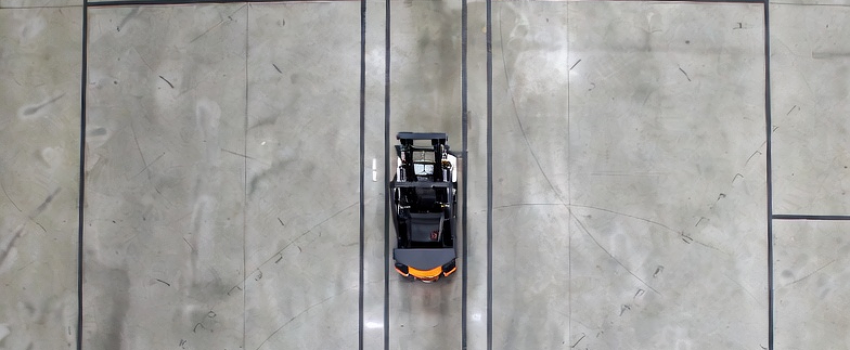
How Moisture Alters Wheel Floor Interaction in AMRs
Robotic mobility depends on consistent friction at the wheel floor interface. Excessive slab moisture alters this interface by reducing surface energy and increasing the likelihood of micro-slip under load. Unlike human-operated vehicles, AMRs rely on precise motion models; even minimal traction variability can disrupt closed-loop control systems.
Moisture affected surfaces may appear dry yet behave inconsistently under rolling loads. This inconsistency leads to uneven torque application, delayed braking response, and subtle oscillations during acceleration. Over time, these effects accumulate, increasing mechanical wear and degrading navigation confidence.
Moisture Driven Surface Instability and Navigation Drift
Moisture migration contributes to micro curling and localized slab distortion, particularly near joints and edges. These deviations may fall within traditional construction tolerances yet still exceed the sensitivity thresholds of robotic guidance systems.
As robots traverse these areas repeatedly, path repeatability degrades. Localization systems compensate through constant correction, increasing computational load and reducing throughput. What appears as a software issue often originates from physical instability within the slab itself.
Coating, Joint, and Surface System Failures Caused by Moisture
Unchecked moisture vapor transmission can compromise coatings, joint fillers, and surface densifiers used to stabilize automated floors. When these systems fail, the floor transitions from a controlled surface to a variable one.
Joint degradation introduces impact zones that affect wheel loading. Coating delamination creates friction discontinuities. These failures rarely stop operations immediately but they erode system trust, increase maintenance intervention, and shorten lifecycle performance.
Why Visual Inspection Cannot Detect Moisture Risk
Concrete moisture risk is invisible at the surface. Visual inspections, surface dryness, or short term environmental readings provide no reliable indication of internal vapor conditions. Accurate assessment requires in-situ relative humidity testing aligned with recognized standards such as ASTM International testing methodologies.
Without quantitative data, automation teams inherit unknown variables that manifest only after robots are deployed when correction is most expensive.
Best Practices for Moisture Control in Automation Ready Floors
Automation ready floors require moisture strategies aligned with system sensitivity. This includes early-stage slab design, controlled curing, verified moisture testing, and surface systems selected for vapor tolerance not just aesthetics or initial cost.
Most importantly, moisture must be treated as a performance input, not a construction afterthought. When concrete behavior is understood and controlled, robotic systems operate within predictable bounds restoring trust between software intent and physical reality.